Practical grouping guide
Random Team Generator: Two People With the Same Name
Give same-name participants distinct labels before using a random team generator. Keep both genuine participants, such as Alex / N01 and Alex / N02. Remove a repeated entry only after confirming it represents the same person twice. Identical labels cannot tell you who an assignment belongs to.
Open the random team generator
Is a repeated name an identity check?
The input has one entry per non-empty line. It does not know whether two lines mean two people or one accidental paste. Automatically removing matching text could exclude someone whose name happens to match another participant.
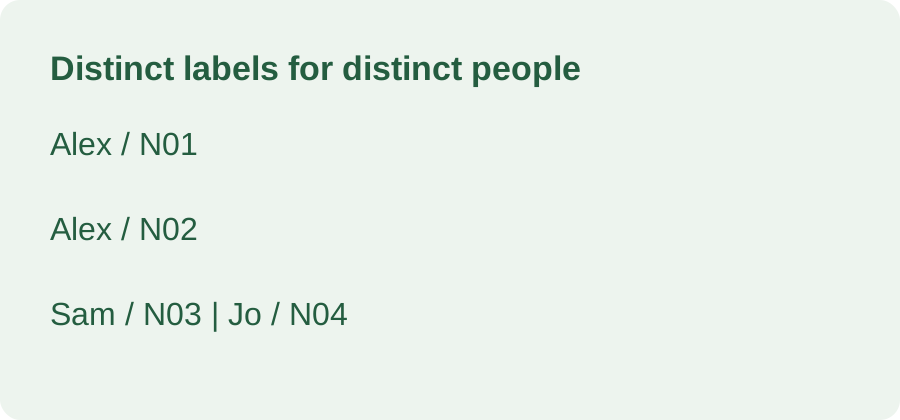
Four entries, two different Alex participants
Our synthetic starting list is Alex, Alex, Sam and Jo, entered on four lines. It represents four intended participants. Generate two teams: the result contains two entries per team and still contains Alex twice. The two Alex entries may be together or apart. Neither placement explains which person should follow which assignment.
For this example, the organizer gives the first Alex the code N01 and the second Alex N02. Sam receives N03 and Jo N04. The corrected labels are Alex / N01, Alex / N02, Sam / N03 and Jo / N04. Keep the private person-to-code mapping with the organizer; a code is useful only if its owner knows it.
Download the label worksheet and practice roster. It includes the ambiguous list, the corrected four-line list and a blank mapping section. These are invented test labels. They do not require surnames, birth dates, school IDs or any real participant details.
We entered the corrected list with surrounding spaces, an empty line and mixed line endings. At widths of 375 and 1280 pixels, the generator kept exactly four non-empty entries, removed their surrounding spaces and preserved the N01 through N04 labels. Each appeared once in the cards and in the TXT download. Your random assignments will differ from the test draw.
Does changing capitalization resolve the identity?
In a separate four-entry test, we entered Alex / N01, alex / N01, Sam / N03 and Jo / N04. Both N01 entries remained in the output. The generator did not merge the uppercase and lowercase spelling. If those lines refer to one person, the organizer must correct the roster; if they refer to different people, they need different codes.
For an accidental repeat, remove only the line you have verified is extra. For two actual Alex participants, keep two lines and two codes. After a correction, generate a fresh draw and replace the previously shared list. This fixture checks entry handling, not identity verification or a guarantee that two specific people will be placed apart.
Can each participant recognize their code?
Ask each same-name participant to confirm their activity code before announcing teams. A displayed label helps only when the person can recognize it. Keep the code spelling stable on your roster, team cards and shared file.
Check the saved list separately
For export integrity, follow the CSV comparison guide. This page solves the earlier identity ambiguity; a correctly exported ambiguous label remains ambiguous. The roster preparation guide covers selecting one version of the list before drawing.