Which tickets can be selected?
Use Range for every integer between Start and End, inclusive. Both endpoints must be whole numbers from zero to one million. Choose one to one hundred draws. No repeats is on by default: each ticket can appear at most once within the current batch, and quantity cannot exceed the eligible pool.
Save the batch you intend to keep before drawing again. Turn No repeats off to draw with replacement. A ticket can then appear several times, even consecutively. A new draw replaces the current batch; it does not remember tickets from earlier batches.
Can you trace five tickets back to their entries?
Our synthetic T01 rehearsal starts at forty-one. Its five input labels are Aster / T01, Birch / T02, Aster / T03, Cedar / T04 and Elm / T05. No real participants are represented. Sequential assignment maps input entries 1 through 5 to tickets 41 through 45. The two Aster labels remain different entries and different tickets; neither should be removed just because their first word matches.
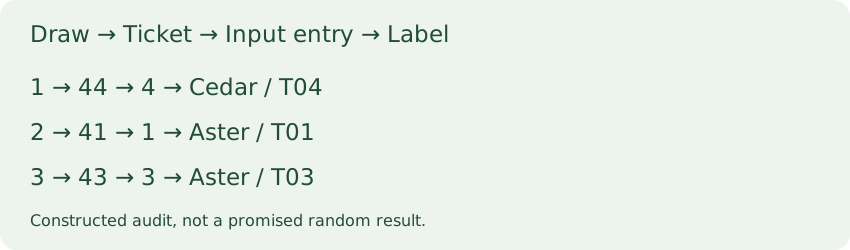
For an independent constructed result, select tickets 44, 41 and 43 in that order. Draw 1 refers to Cedar / T04, input entry 4; draw 2 refers to Aster / T01, entry 1; draw 3 refers to Aster / T03, entry 3. This is an audit fixture, not the sequence promised by the random button. Check each ticket against the input mapping rather than assigning the first input name to the first selected ticket.
Comparing all three fields catches a problem that a winner count alone cannot reveal. Damage a copy by attaching Aster / T01 to ticket 43. The file still has three draws, three distinct tickets, and numbers within 41 through 45. Those total and range checks pass, yet the association is wrong: ticket 43 belongs to input entry 3, Aster / T03.
Load the five-ticket example and request all five tickets with No repeats on. Any result order is acceptable if tickets 41 through 45 each appear once and each retains its matching input entry and label. Increase quantity to six and generation stops. With repeats allowed, six draws are valid and at least one ticket must occur again; there are only five eligible tickets. Repeating a ticket also repeats the name attached to it.
How are names assigned to numbers?
Choose Names with sequential tickets, enter one label per line, and set the first ticket. Blank lines are ignored and surrounding spaces removed. Up to one thousand non-empty entries are accepted, with eighty characters each. The final assigned ticket must not exceed one million. End is unused in this mode; the input-entry count determines the last ticket.
Each non-empty entry receives one ticket, including repeated labels. This mode does not import a sold-ticket register, accept arbitrary ticket-to-name pairs, or verify eligibility. If your actual tickets have gaps or existing assignments, do not treat a new sequential mapping as that register. Decide which inputs belong before using the result.
Which file matches this draw?
For a separate synthetic file check E01, use two names: =Plan / E01 and Check, "pair" / E02, starting at seven. Request both without repeats. Ticket 7 must always carry input entry 1 and =Plan / E01; ticket 8 must carry entry 2 and the full comma-and-quote label. The random order can reverse, but the pairings cannot. A CSV parser must return four cells per data row, not split the second label at its internal comma.
The E01 CSV has two data rows plus its header. Its first label includes a leading apostrophe before the equals sign for spreadsheet protection, while TXT and the screen keep =Plan / E01. The second label retains both quotation marks after CSV decoding. Compare the draw number, ticket and input entry too: sorting the ticket column alone without moving its names would corrupt the association even though both original ticket values remained.
CSV uses Draw, Ticket, Input entry and Name columns. Range-only results leave the final two cells empty. TXT and print show the same current result. CSV quotes commas and quotation marks and prefixes an apostrophe before text starting with =, +, @ or -. Already downloaded files do not update after an edit.
Does this generate football pool numbers?
No. A football squares board needs two separately ordered sets of digits, one for each axis. This page selects tickets from one eligible pool; it does not generate that board, match scores, accept stakes or manage payouts. Keep those different rules separate. It also does not certify a drawing or provide an independently verifiable record.
Where does the draw run?
The selection uses browser random values, with rejection before mapping to the eligible range. No weights are applied. Labels and results stay in this tab, without an account or cloud history; they are not sent to analytics or put in sharing URLs. Reloading clears them. Editing any input clears the current result and file links.
Need the whole list in a new order? Use the list randomizer. Need people split into groups? Use the team generator. This page selects numbered entries rather than assigning teammates or ordering every item.