Random team generator · Practical answers
Random Team Generator for Uneven Groups: 31 People, 6 Teams
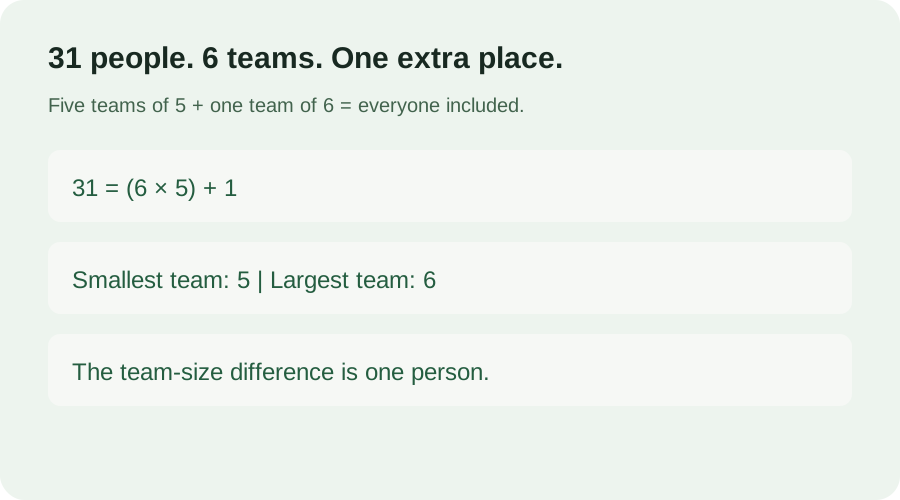
For 31 people and 6 teams, make one team of 6 and five teams of 5. Spread the extra people across the teams so each larger team gets just one extra member. If every team must stay at 5 people or fewer, choose 7 teams.
Open the random team generator →
Six tables, or a maximum of five people per table?
Choose the constraint before drawing. A fixed number of tables and a strict limit on people per table lead to different plans.
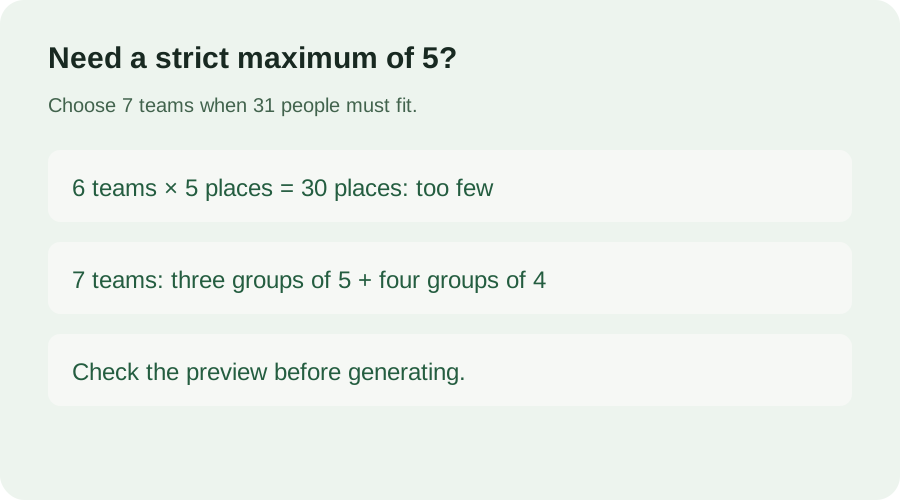
If you have six tables, use six teams with sizes that differ by one. If each table holds at most five people, six tables provide only thirty places. Thirty-one people need another table or a different arrangement.
Randomizing names decides who joins each team. It cannot create seats, equalize experience or decide whether your activity can accommodate another participant.
Try the complete 31-person example
Download the 31-label practice roster. It uses synthetic labels P01 through P31, so you can try the workflow without a real attendee list.
Paste one label per line, enter six in Number of teams, and check the preview: five teams of five and one team of six. Generate once. The members can change between draws; the size plan should stay the same.
The table below is a constructed allocation for checking the count. It is not a saved random draw.
| Team | Participant labels | Count |
|---|---|---|
| A | P01, P07, P13, P19, P25, P31 | 6 |
| B | P02, P08, P14, P20, P26 | 5 |
| C | P03, P09, P15, P21, P27 | 5 |
| D | P04, P10, P16, P22, P28 | 5 |
| E | P05, P11, P17, P23, P29 | 5 |
| F | P06, P12, P18, P24, P30 | 5 |
Does your draw include every label once? Check all thirty-one labels and the team counts. Six plus twenty-five accounts for everyone without a solo group. Your random teammates will differ from this table.
Give the larger discussion team one shared output, like the others. One participant can read the prompt and another can keep notes, with everyone contributing. These optional roles do not guarantee better performance or an earlier finish.
Export TXT to keep your chosen draw. Review the labels before sharing. If you reshuffle, replace the saved version so participants follow one team list.
Calculate the team sizes
Divide N people by K teams. Let q be the whole-number quotient and r the remainder. Make r teams of q + 1 and K − r teams of q. For 31 and 6, q = 5 and r = 1. This balances size, not ability.
Size checks with this generator
We checked these team sizes in the browser using synthetic labels. They verify this site's size handling, not learning outcomes or other tools.
| People | Teams requested | Result sizes |
|---|---|---|
| 13 | 3 | 5, 4, 4 |
| 17 | 4 | 5, 4, 4, 4 |
| 31 | 6 | 6, 5, 5, 5, 5, 5 |
| 29 | 6 | 5, 5, 5, 5, 5, 4 |
| 1 | 8 | 1; the requested count is limited to one team |
Does the input counter match your roster? Empty lines are ignored; repeated names remain separate entries. Use labels such as Alex R and Alex S for different people with the same name. Remove accidental duplicates before drawing.
Can every team be exactly equal?
Only when the people count divides evenly by the team count. For thirty-one people and six teams, you must change a requirement to get equal whole-person groups. Do not leave someone out to make the numbers match.
How do I enforce a maximum team size?
Divide the people count by the maximum size and round up. Thirty-one divided by five is 6.2, so choose seven teams. This generator then gives three teams of five and four teams of four.
Should I reshuffle until the teams look fair?
Set your requirements before drawing. Size-balanced teams can still group people with similar experience. This generator does not apply ability balancing or keep-apart rules; use a method that supports those conditions if you need them.
Use the chosen draw in a team worksheet or workshop discussion record.