Practical grouping guide
Random Group Generator: Check Repeated Partners Across Rounds
Save each accepted round and compare the unordered pairs inside its groups. A random group generator can produce old partners again. Random Team Split does not remember previous rounds or automatically avoid repeats, so use a separate ledger to check them.
Does a different team number mean new partners?
Team 1 and Team 2 are labels for the current draw. A pair can move to another numbered group and still be the same two participants. Use stable person labels throughout the activity and compare members, not just team numbers.
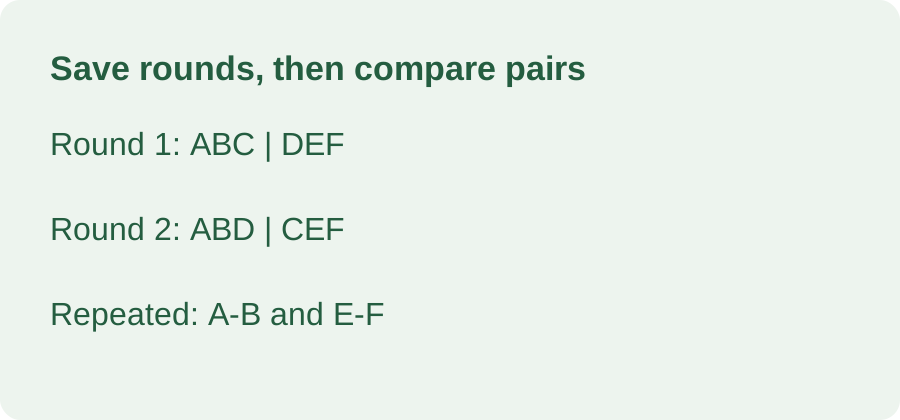
A six-person, two-round worked ledger
We constructed these rounds for six synthetic participant labels A, B, C, D, E and F. They are teaching examples, not random outputs promised by the generator. Round 1 has groups A B C and D E F. Round 2 has groups A B D and C E F. Each round uses all six labels once, with three people in each group.
| Round | Group 1 | Group 2 |
|---|---|---|
| 1 | A B C | D E F |
| 2 | A B D | C E F |
Expand each triple into three pairs. Round 1 contains A-B, A-C, B-C, D-E, D-F and E-F. Round 2 contains A-B, A-D, B-D, C-E, C-F and E-F. Write each pair in one fixed order, so B-A is counted as A-B rather than a new partnership.
The two rounds give twelve pair occurrences. Ten pairs are distinct. A-B occurs twice and E-F occurs twice; every other listed pair occurs once. We checked these totals with a script that enumerates each group's two-person combinations and counts the sorted labels. Counting only how many groups changed would miss both repeats.
Download the worked ledger and blank recording template. The file includes both rounds, all pair counts and blank spaces for your own accepted rounds. Record the participants, groups and date or round label before making the next draw. Keep one stable roster code per person.
Which pairs appear in your actual draw?
For a six-person trial, paste A through F on six lines into this site, choose two teams and generate. Save TXT before pressing Shuffle again. Your triples need not match our constructed rounds. Enumerate the pairs from your actual saved groups, then repeat for the next accepted draw.
If your first group is A C E, its pairs are A-C, A-E and C-E. Compared with our two-round ledger, A-C and C-E have already appeared; A-E has not. This is a separate hypothetical check, not a third completed round or a claim that the tool selected that group.
Mark an occurrence when both people share a group in an accepted round. An abandoned preview should not become activity history unless your chosen policy counts previews. Keep that policy consistent. The downloadable template separates accepted rounds from notes about rejected draws.
What should happen when a pair repeats?
Agree on the rule before drawing. You might allow repeats, prefer fewer repeats, or require none. Checking a saved draw detects repeats; it does not guarantee that a valid no-repeat schedule exists for your group sizes and number of rounds.
Does shuffling again guarantee a solution?
No. This tool makes another draw without considering the ledger. If you need strict restrictions, use a method that explicitly enforces them and check its result. Do not describe repeated manual shuffles as an automatic no-repeat feature. For fixed teams with changing tasks instead, use the role rotation sheet.