Candidate record review
Check one-prize-per-person results when raffle tickets do not repeat
Published:
Keep candidate order separate from accepted award order. Distinct ticket numbers do not guarantee distinct winners. Under an agreed one-prize-per-person rule, compare ownership too: a candidate belonging to an already accepted owner must not consume another award slot.
Confirm the published policy before applying an owner limit. This guide audits a constructed record; it does not run a drawing or decide an event's rules. If policy or ownership is unclear, stop rather than changing the rule after seeing names.
Which owner belongs to each ticket?
Our invented register has six tickets: 101, 102 and 104 belong to owner A; 103 and 105 belong to B; 106 belongs to C. These owner codes are local rehearsal labels, not verified identities. The reference order is 104, 101, 103, 105, 102, 106. It was authored for this example, not captured from a random generator.
The rule for this rehearsal is three award slots, at most one per owner, processed in that fixed order. Owner lookup must come from the reference register. A displayed name, an input-entry number and a ticket number are not interchangeable evidence of ownership.
Do three distinct tickets fill three awards?
Candidate 1 is ticket 104, owned by A, so A fills award 1. Candidate 2 is ticket 101. Its number differs, but owner A already holds an award. Mark that candidate skipped and leave the next award available. Candidate 3 is ticket 103, owned by B, which fills award 2. Three distinct tickets have supplied only two accepted owners.
Stopping at those first three candidates loses C entirely. Continue the authored record: candidate 4, ticket 105, also belongs to B and is skipped; candidate 5, ticket 102, belongs to A and is skipped. Candidate 6, ticket 106, belongs to C and fills award 3. The accepted tickets are therefore 104, 103 and 106, at candidate positions 1, 3 and 6.
| Candidate | Ticket | Owner | Result |
|---|---|---|---|
| 1 | 104 | A | Award 1 |
| 2 | 101 | A | Skip |
| 3 | 103 | B | Award 2 |
| 4 | 105 | B | Skip |
| 5 | 102 | A | Skip |
| 6 | 106 | C | Award 3 |
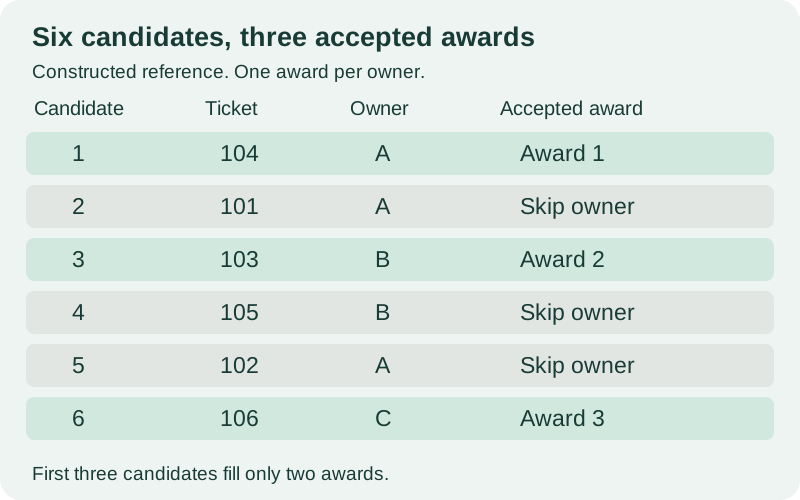
Deleting the repeated-owner row from a three-row export does not complete this rehearsal. It leaves two awards, even if the remaining tickets are all different. A review needs the later candidate record or the event's documented continuation procedure. Do not invent a missing candidate, promote an unrecorded person or silently label raw candidate 3 as award 3.
Which candidates stay in the audit trail?
Record the candidate position, ticket, owner, decision and accepted award number. The three skipped rows remain part of this reference; an empty award cell explains why a candidate did not advance the award counter. Save the original candidate stream alongside the completed review, not just the three accepted rows.
The raffle number generator labels its setting as no ticket repeats within a batch. Its output is not a person-level eligibility certificate. This guide's owner reference and decisions are separate manual records, not an added feature or a certified draw.
Some tools already document the distinction: Pick & Shuffle explains that identical labels can represent different entries, while TwirlPick describes buyer-weighted selection. This worked record focuses on candidate-versus-award positions, not an invention of the one-prize rule.
Download the synthetic ticket-owner register, candidate order and completed review to follow the same six rows.