Sharing results · Inspect the data
An unreadable team-result link can still contain the names
Published:
Treat a team-result link as containing participant names if those names can be recovered from it, even when the address looks unreadable. Our saved GigaSpinner test link exposed no readable labels in its address, but a local decoding check recovered all four labels and their groups. Use labels you can share, or deliver the result through a channel with access controls you have actually checked.
We tested this on October 29, 2026, using four invented entries: S01 Aster, S02 Birch, S03 Cedar and S04 Elm. In GigaSpinner's Random Team Generator, we selected two groups, applied the list, then opened Share and Result link. We did not send it to a social network or enter a real roster.
What was inside the recorded link?
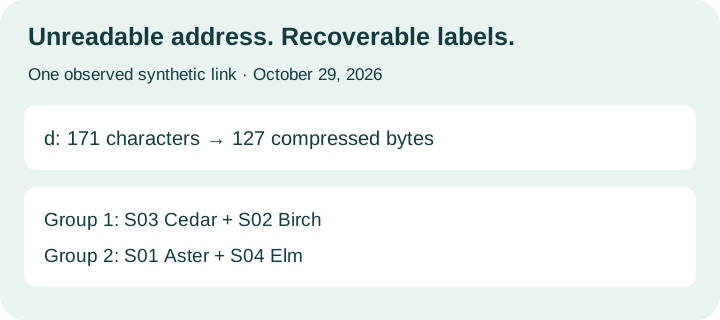
The displayed draw put S03 Cedar and S02 Birch in Group 1, with S01 Aster and S04 Elm in Group 2.
The generated address used a d query parameter containing 171 characters. Neither the four literal labels nor their percent-encoded forms appeared in that address.
That exact link reopened both groups in another browser tab. The result page did not ask us for a password during this test.
This observation concerns the tested session, not every sharing mode or its network traffic.
Both complete groups were recoverable locally. For the saved sample, removing the initial z marker and Base64url-decoding the remainder produced 127 bytes. Inflating those bytes as raw DEFLATE recovered a JSON record whose g field contained both complete groups. We compared that field with the visible result and retained the exact decoded text.
The local replay reads just the saved URL and decoded-text files. It recovered both complete groups without obtaining a key or account token from the website. No server request is part of that check. The unreadable address was therefore not a boundary hiding these labels from someone holding this particular link.
What does this check establish?
GigaSpinner already explains that its teams are stored in the link. The dated link, recovered fields and runnable comparison document what that meant for this test. Other tools may use different link formats and access rules; do not apply this decoder or conclusion to them without testing.
What should you share instead?
Before sharing a real roster, check what the recipient can recover and who can open the destination. A settings-only URL and a result URL are different things. A screenshot or CSV still exposes any names inside it; changing the file type does not restrict its audience. Random Team Split's form does not create a result-sharing URL: its CSV and TXT downloads remain files you choose where to send.
Files and local replay
The replay uses Node.js Buffer and zlib. Its files contain invented labels only.